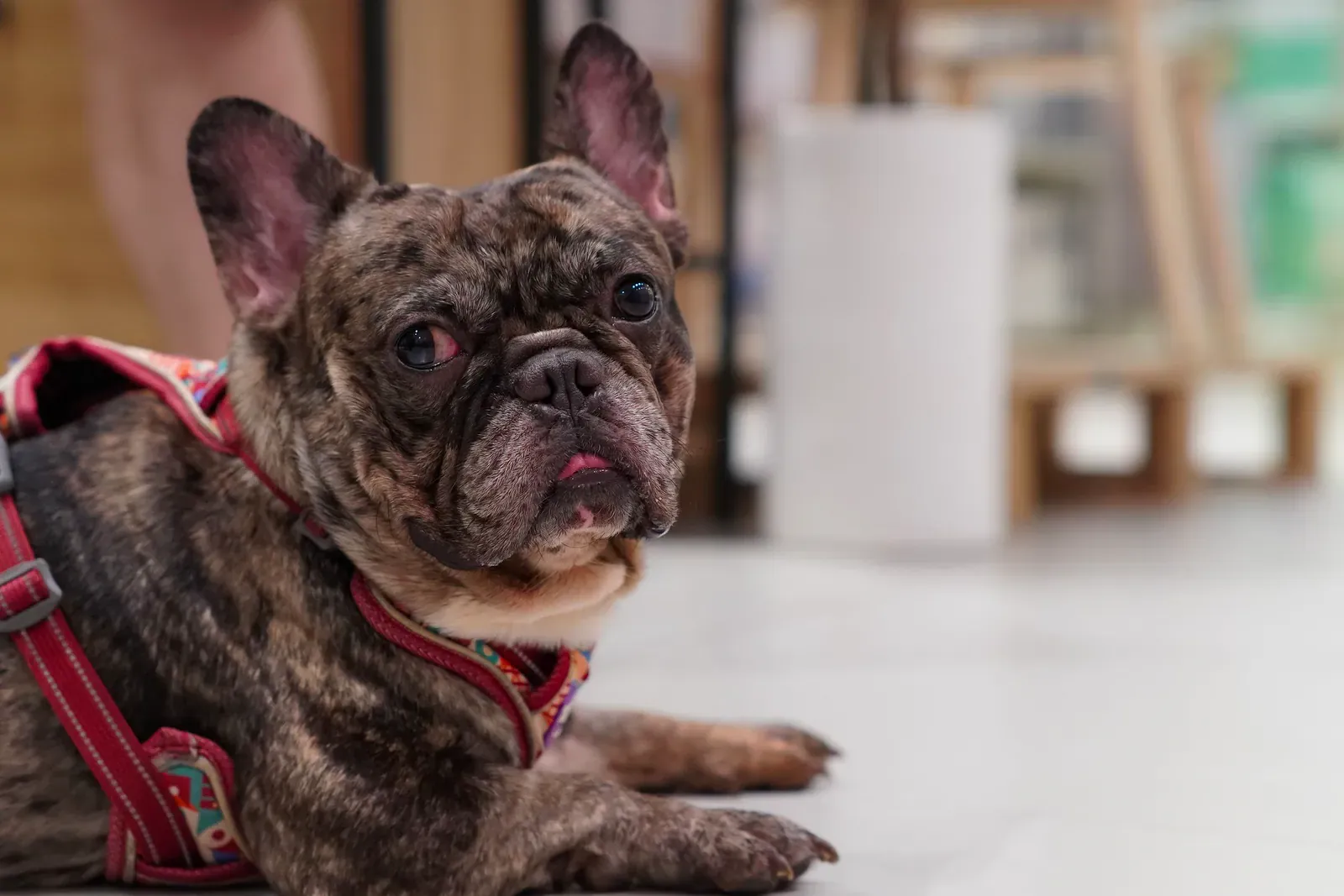
It was developed in Paris in the mid-19th century from small English bulldogs. It is now one of the most popular dog breeds in the world, and also one of the most debated. Its short skull is linked to breathing disease known as brachycephalic obstructive airway syndrome (BOAS), and UK veterinary studies show shorter life expectancy than most breeds. It suits owners who want a modest-exercise indoor companion and accept real health costs and risks.
French Bulldog quick facts
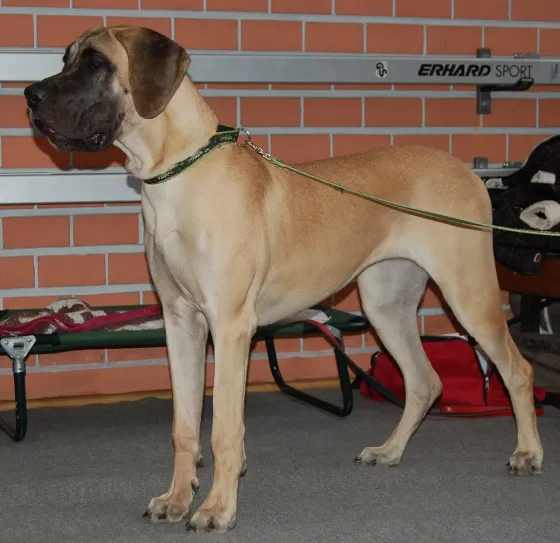 Related breedGreat Dane1600 to 1880 · Germany
- Closest DNA relatives
- Bulldog, Boston Terrier, Staffordshire Bull Terrier
- Descendant breeds
- None recorded in the project data
- Country of origin
- France (Paris), from English toy bulldogs
- Period of development
- About 1850 to 1898 (project data)
- Parent breed
- Toy Bulldog (project data, medium confidence), mixed with local Parisian ratters
- Type
- Companion dog (FCI Group 9, Companion and Toy Dogs, standard no. 101; AKC Non-Sporting Group; UK Kennel Club Utility Group)
- Height
- About 27 to 35 cm for dogs and 24 to 32 cm for bitches (breed reference works)
- Weight
- AKC standard: not more than 12.7 kg (28 lb). Reference works list about 8 to 14 kg
- Coat
- Short, smooth, fine, close-lying
- Colours
- AKC standard allows brindle, fawn, white and brindle and white. Some colours disqualify in the show ring
- Life span
- Project data: 4.5 to 12 years (breed clubs say 10 to 12). UK life tables give a far lower life expectancy from birth (see health section)
- Exercise
- Short, moderate walks. Heat and effort limit it
- DNA family
- European Mastiff (Parker et al. 2017)

Where does the name "French Bulldog" come from?
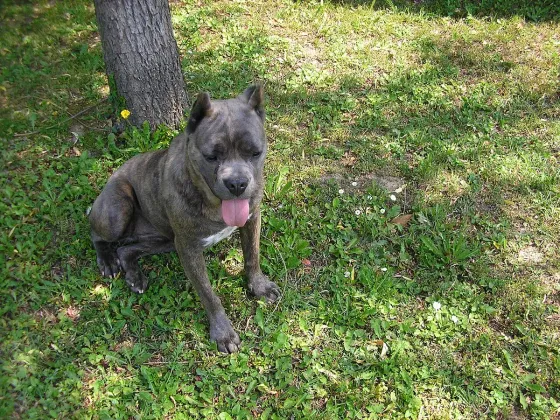
 Related breedChihuahua1850 to 1904 · Mexico
The name states the story: a bulldog developed in France. In French the breed is the Bouledogue Francais, and the FCI lists it under that name with France as country of origin. The project data describes the name as marking its development in France from English toy bulldogs.
"Frenchie" is the common pet name. The word "bulldog" itself refers to the old English dogs used in bull-baiting. The French Bulldog is not a bull-baiting dog. It was bred small, as a pet.
The Kennel Club in Britain first accepted the dogs in 1905 under the name Bouledogue Francais, according to breed histories, and the "French Bulldog" name followed later. Sources give different dates for the English-language name, so treat 1912 as approximate.
What is the history of the French Bulldog?
 Same eraDobermann1880 to 1900 · Germany
English toy bulldogs
In the 19th century Britain had a range of bulldogs, including small "toy" sizes. Breed histories widely tell that lace workers in Nottingham kept small bulldogs as companions. When machine lace-making cut work in the mid-19th century, many workers moved to Normandy and Paris in France, and brought their dogs with them. The story is repeated in nearly every popular history of the breed. Contemporary written proof for each step is thin, so read it as the accepted account, not a fully documented chain.
The project data lists the Toy Bulldog as the Frenchie's parent, with medium confidence. It also records an old line of ancestors behind it, from the Old English Bulldog and the English Mastiff back to older mastiff types.
Paris in the mid-19th century
In Paris the small bulldogs were crossed with local dogs, described in breed histories as ratters. The dogs became fashionable as lap and shop dogs among Parisians. The project dates the breed's appearance to 1850 to 1898, a period when many modern breeds were being fixed and named.
Bat ears and the American influence
Early dogs often had rose ears, folded like the English Bulldog's. The upright "bat" ear became the signature of the breed. Breed histories say French and American fanciers preferred it, and that the shape was fixed through selection. The exact path of that choice is told differently in different histories.
Kennel club recognition
| Year | Event |
|---|---|
| 1898 | AKC recognises the breed (per breed histories) |
| 1905 | UK Kennel Club accepts the breed (per breed histories) |
| Later | FCI standard no. 101, Group 9, with France as country of origin |
The FCI lists the breed as definitive. The AKC places it in the Non-Sporting Group, and the UK Kennel Club recognises it as well.
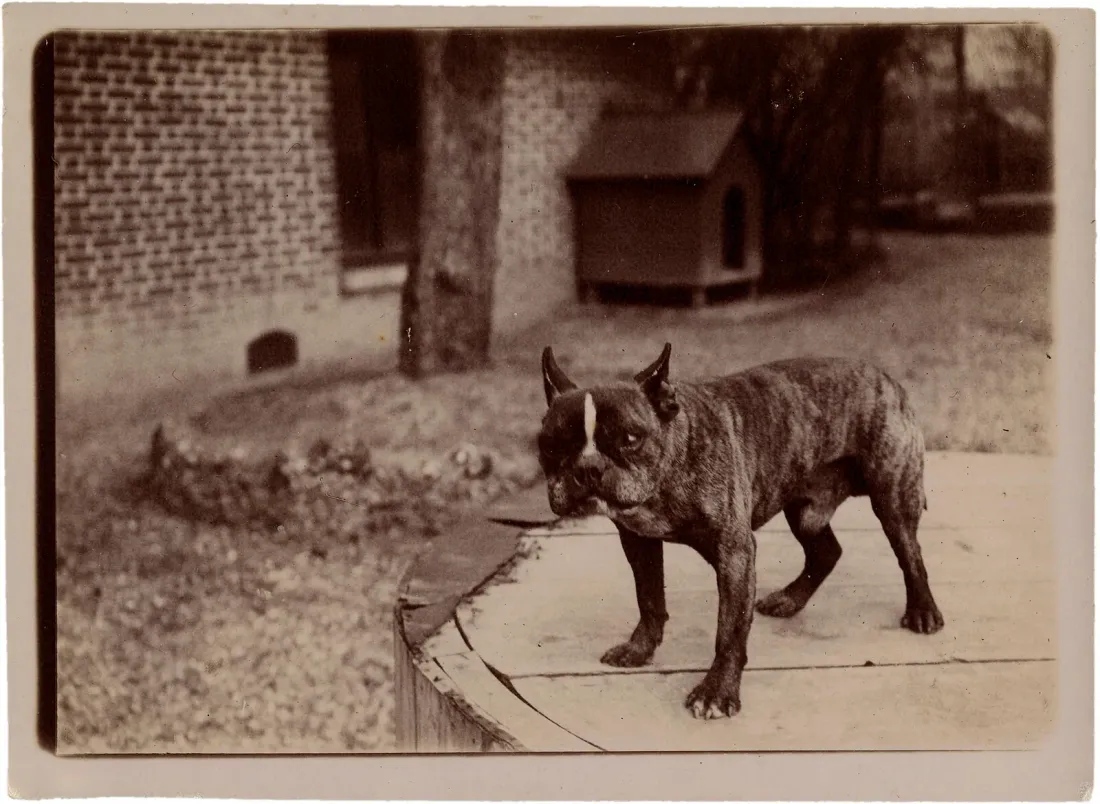


Which breeds are ancestors, descendants and relatives of the French Bulldog?
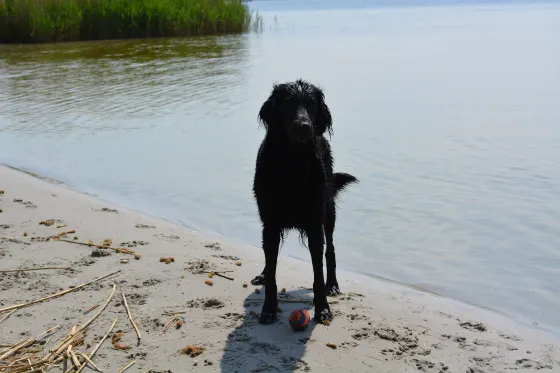 Same familyFlat-coated Retriever1860 to 1880 · United Kingdom
Ancestors (project data)
- Toy Bulldog. The direct parent in the knowledge base, medium confidence. Small English bulldogs brought to Paris and crossed with local ratters.
- Old English Bulldog. An earlier ancestor, behind the Toy Bulldog.
- English Mastiff. A distant ancestor in the mastiff line.
- Older entries in the lineage record are the Alaunt, Canis pugnax and the Alpine Mastiff. These deep links are weaker and partly traditional.
Descendant breeds. The project data lists none.
What does DNA say?
A 2017 study by Parker and colleagues (Cell Reports) analysed 1,346 dogs from 161 breeds and sorted them into 23 supported clades. The French Bulldog sits in the European Mastiff clade, with strong support. The study also measured shared , long stretches of identical DNA that two breeds inherited from common ancestors. More shared (Mb) point to crossing or shared founders. The study cannot say which way the genes flowed.
Source: Parker et al. 2017, as recorded in this site's breed database.
The Bulldog tops the list, which fits the history. The Boston Terrier is second. The Staffordshire Bull Terrier and Boxer, both bulldog-type breeds, follow. The terrier entries lower down may reflect the terrier blood in old bulldog stock, though the study does not explain them.
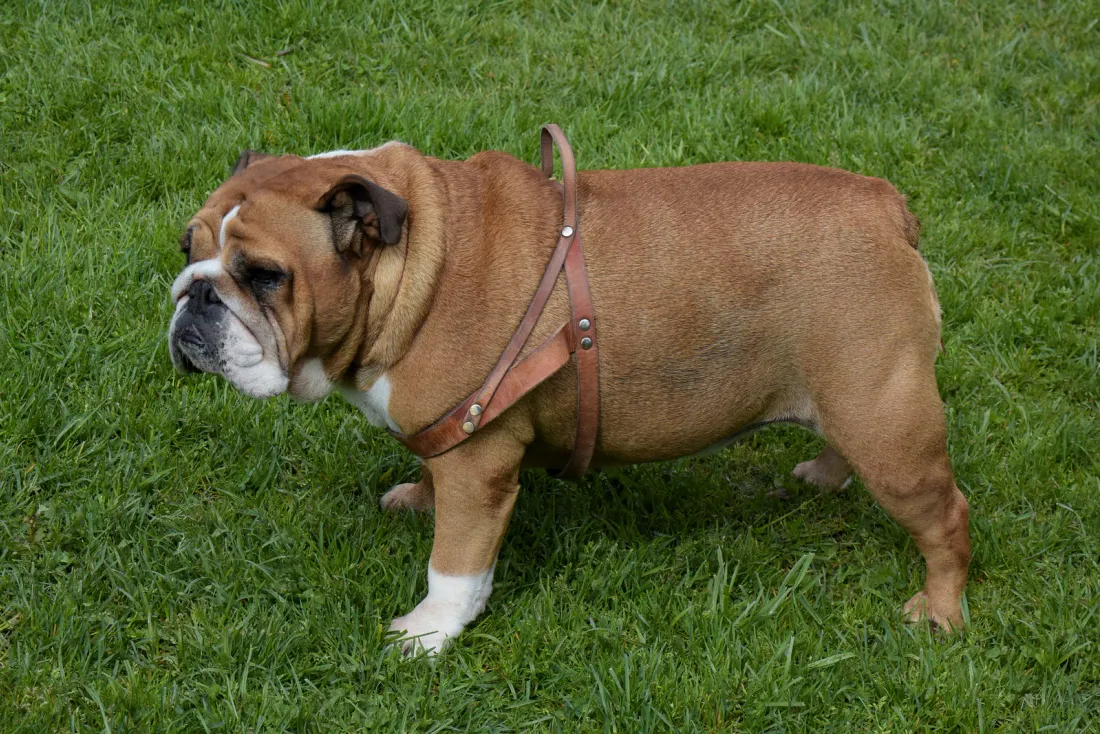
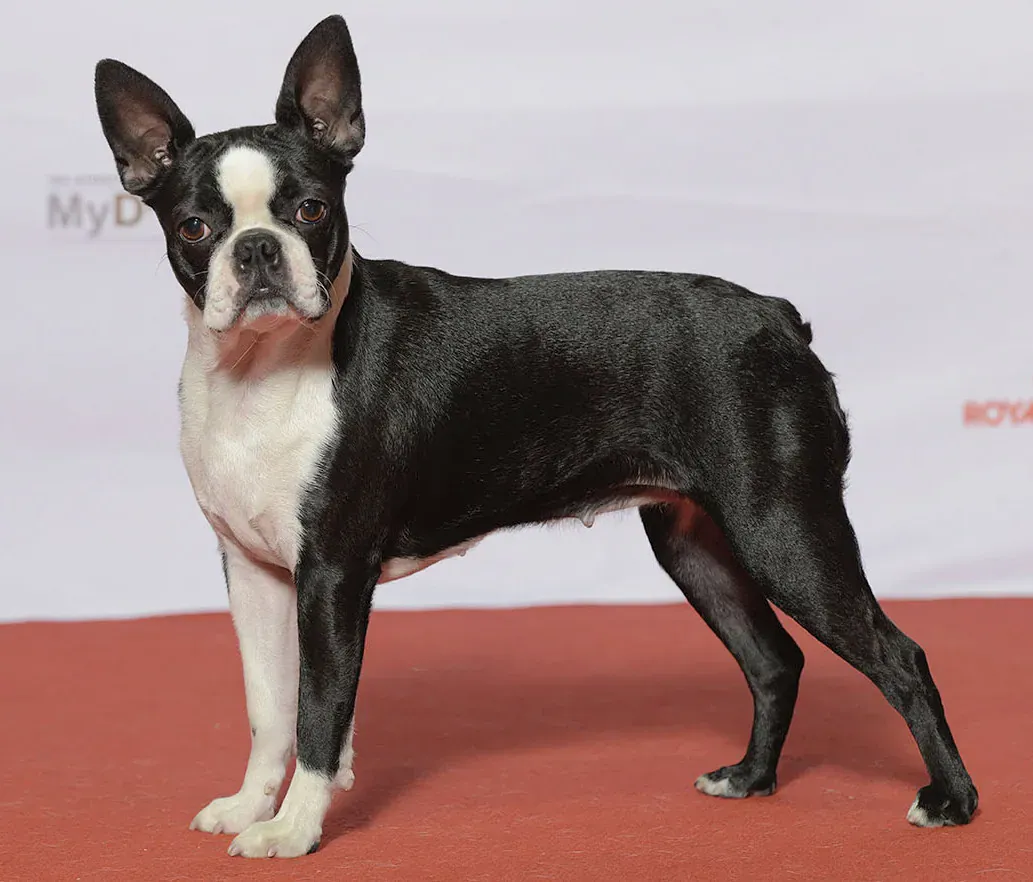
- Bulldog27.8 Mb 1.2%
- Boston Terrier24.1 Mb 1.0%
- Staffordshire Bull Terrier19.6 Mb 0.8%
- Boxer17.8 Mb 0.7%
- American Staffordshire Terrier16.0 Mb 0.7%
- Dogue de Bordeaux15.1 Mb 0.6%
- Soft-coated Wheaten Terrier11.7 Mb 0.5%
- Boerboel11.2 Mb 0.5%
- Glen of Imaal Terrier10.8 Mb 0.5%
- Kerry Blue Terrier10.2 Mb 0.4%
Source: Parker et al. 2017. Percent of the whole genome.
| Breedwith French Bulldog | Shared DNA with French Bulldog (Mb)Shared DNA (Mb) |
|---|---|
| Bulldog | 27.8 |
| Boston Terrier | 24.1 |
| Staffordshire Bull Terrier | 19.6 |
| Boxer | 17.8 |
| American Staffordshire Terrier | 16.0 |
| Dogue de Bordeaux | 15.1 |
| Soft Coated Wheaten Terrier | 11.7 |
| Boerboel | 11.2 |
| Glen of Imaal Terrier | 10.8 |
| Kerry Blue Terrier | 10.2 |
How big is a French Bulldog and what does it look like?
 Looks relatedGerman Shepherd1899 · Germany
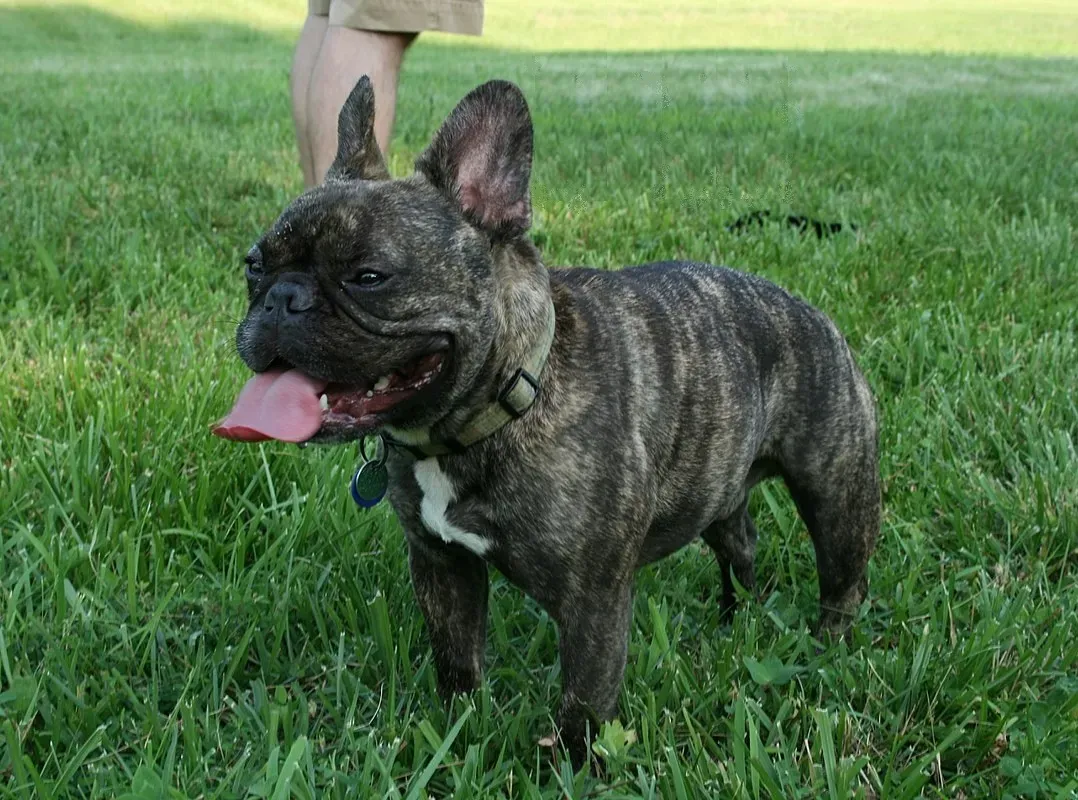
The French Bulldog is a small dog with a heavy bone for its size. Reference works describe a muscular, compact body, broad chest, short back that rises over the loin, and a short, screw or straight tail. The head is large and square, with a flat skull, very short muzzle and thick skin folds (rope) around the nose.
- Height. About 27 to 35 cm for dogs and 24 to 32 cm for bitches (reference works).
- Weight. The AKC standard sets a maximum of 12.7 kg. Reference works list about 9 to 14 kg for males and 8 to 13 kg for females.
- Head. Wide, flat skull. Muzzle very short, with a broad nose. The short muzzle is the root of the breed's breathing problems.
- Eyes. Round and dark, set low and wide apart.
- Ears. Erect and wide at the base, rounded at the top (bat ears).
- Coat. Short, fine and smooth. Little grooming is needed, but facial skin folds need regular cleaning and drying.
- Colours. The AKC standard accepts brindle, fawn, white, and brindle and white, with some other colours disqualified. Pied and cream are common. Blue, lilac and similar shades are sold by some breeders but are not accepted in main standards.
Check the current standard of your own kennel club before showing or breeding. Colour rules differ by club and change over time.



What is the French Bulldog's temperament like?
 Related breedGiant Schnauzer1850 to 1923 · Germany
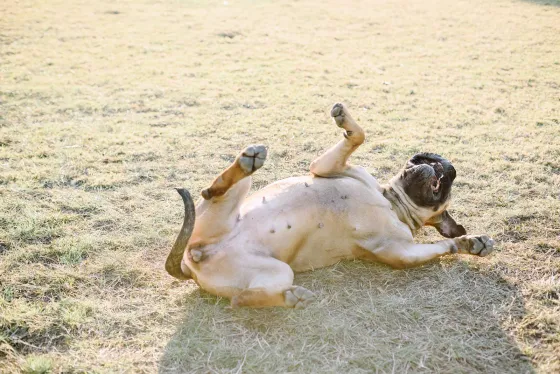
The AKC describes the breed as adaptable, playful and smart, and breed histories call it a companion that bonds closely with its people. It was bred as a house pet, not as a worker, so it has no herding or hunting drive to keep occupied. Most Frenchies enjoy short play sessions and long periods of lounging.
Temperament varies between dogs. Social experience in the first months, health and pain all influence behaviour. A dog that struggles to breathe in effort or heat will often avoid play, which owners can mistake for laziness. Sources agree that the breed does best with company and does not do well left alone for long periods.
Training is usually easy with short sessions and food rewards. Stubbornness is often cited in breed profiles. Treat it as a tendency, not a rule.
What are the exercise and heat needs of a French Bulldog?
 Related breedGolden Retriever1868 to 1911 · United Kingdom
A short, flat muzzle means less room for airflow. Dogs cool themselves by panting, so a dog with a narrow airway loses heat poorly. This is the main reason Frenchies need extra care in warm weather.
- Keep walks short and moderate, and plan them for cool parts of the day.
- Stop if the dog snorts loudly, struggles, or lies down and refuses to go on.
- Avoid hot cars and hard exercise on warm days. Heat can push an affected dog into collapse.
- Keep the dog at a lean body weight. Extra fat narrows the airway further (Liu et al. 2017).
What health problems affect French Bulldogs?
 Related breedMiniature Schnauzer1888 to 1899 · Germany
The French Bulldog is a brachycephalic breed, meaning short-skulled. The shortened skull changes the airway, the eyes, the spine and the skin. The key sources below are UK studies from the Royal Veterinary College (RVC), the University of Cambridge and the Kennel Club.
Brachycephaly and BOAS
Brachycephalic obstructive airway syndrome (BOAS) is a set of airway problems caused by the skull shape. Typical features are narrow nostrils (stenotic nares), a long soft palate, and a narrow windpipe. Signs include noisy breathing, snoring, exercise intolerance, overheating and, in severe cases, collapse. Surgery can widen nostrils or shorten the palate in many dogs, and a vet should assess each case.
Liu and colleagues (PLoS ONE, 2017) measured 604 pugs, French Bulldogs and Bulldogs at Cambridge. They found that stenotic nostrils, a higher body condition score (fatter dogs) and a high neck girth ratio (thick neck relative to head) were valid, easy-to-use predictors of BOAS. Their results support the point that weight control and both matter.
The University of Cambridge and the UK Kennel Club developed the Respiratory Function Grading Scheme to assess Bulldogs, French Bulldogs and Pugs. It grades dogs after exercise, and a dog graded 3 is the worst category. For Crufts 2025, the Kennel Club said eligible French Bulldogs needed a valid grading result, and grade 3 dogs could not enter. From 1 January 2025, the Kennel Club placed the French Bulldog in Category 3 of Breed Watch, its list of breeds with visible health concerns tied to exaggerated conformation.
What UK veterinary studies show
| Study | Finding |
|---|---|
| O'Neill et al., Canine Genetics and Epidemiology, 2018 | study of French Bulldogs under UK vet care in 2013. The most common disorder groups were skin (17.9%), digestive tract (16.7%), ear (16.3%), upper respiratory (12.7%) and eye (10.5%). Most common single disorders: otitis externa, diarrhoea and conjunctivitis |
| O'Neill et al., Canine Medicine and Genetics, 2021 | 2,781 French Bulldogs compared with 21,850 other dogs. Frenchies differed on 31 of 43 common disorders and had lower risk for 11 of them. BOAS: odds ratio 30.89. Stenotic nares: odds ratio 42.14 |
| Teng et al., Scientific Reports, 2022 | UK life tables from 30,563 dogs that died 2016 to 2020. French Bulldog life expectancy at birth: 4.53 years, the shortest of the breeds studied, with Bulldog, Pug and American Bulldog also very low |
Two things matter when reading these numbers. First, an odds ratio of 30.89 means Frenchies were about 31 times more likely than other dogs in the sample to be recorded with BOAS. Second, the 4.53 years is life expectancy from birth, which includes puppies and young dogs that die early. It is not the typical age a healthy adult dies at, and it is far from the 10 to 12 years in the project data. The authors linked the short expectancy to life-limiting conditions such as BOAS, spinal disease and difficult births.
Other conditions
The 2021 and 2018 RVC papers also list eye, ear and skin problems. Typical items in veterinary breed guides include corneal ulcers (from prominent eyes), skin fold dermatitis, allergic skin disease, spinal malformations and disc disease, and the need for caesarean births in many litters. Caesarean-birth and spinal figures are not quoted here, as no single current source was checked for them.
Information here is general. Talk to a vet about your own dog, and read the Kennel Club Breed Watch notes if you plan to breed.
 Ticks and fleasTicks and fleas on dogs: how to check, remove and prevent themTicks and fleas on dogs: how to tell them apart, check your dog, remove a tick safely, break the flea life cycle and prevent both.
 GuidesPractical guidesBehaviour, training, health and adoptionRelated breedMiniature Schnauzer1888 to 1899 · Germany
Why is the French Bulldog so popular?
 Related breedRat Terrier1890 to 1999 · United States
The rise is steep and recent. Reported figures:
- United States. The American Kennel Club reported that the French Bulldog became the most registered breed in 2022, ending the Labrador Retriever's 31-year run. AKC data placed the Frenchie at number 14 in 2012. It has held the top spot in the years since, according to the AKC's later lists.
- United Kingdom. Kennel Club data cited by the RVC and press show registrations rising from 692 in 2007 to 21,470 in 2016. Kennel Club figures reported in the press then show a fall, to 7,750 registrations in 2025, a drop of about 64 percent from the 2016 peak. These are Kennel Club registrations only and miss dogs sold without papers, so the true population is larger.
Reasons given in the veterinary and welfare literature include the breed's size for apartment living, its cute face (some researchers write of "baby-like" features), exposure in advertising and social media, and celebrity ownership. These are explanations researchers offer, not proven causes.
Popularity has a welfare side. Rapid demand attracts breeders and importers who do not health-test, and puppies sold outside the registered system have no grading or screening at all.
Is breeding French Bulldogs a welfare problem?
 Related breedYorkshire Terrier1850 to 1874 · United Kingdom
This is the most contested topic around the breed. Facts first, then the positions.
What courts and governments have done
- Norway. In 2022 the Oslo District Court ruled that breeding English Bulldogs and Cavalier King Charles Spaniels as they were bred breached Norway's Animal Welfare Act. The Supreme Court gave a final verdict in October 2023 on the Cavalier, and ruled that Bulldog breeding must fit new frameworks. Press reports note that the reasoning could also reach the French Bulldog and Pug. It did not ban Frenchies by name.
- The Netherlands. Dutch rules limit breeding of dogs with very short muzzles, measured as muzzle length against skull length. A later court ruling reported in press ordered the Dutch kennel club to stop issuing pedigrees for dogs with a muzzle shorter than one third of skull length. Details have changed over time, so check current rules.
What vets and researchers say. The RVC's VetCompass team, after its 2021 study, warned prospective buyers to stop and think before getting a flat-faced dog, saying the French Bulldog is no longer a "typical" dog in health terms. The RCVS Knowledge resource on the health and welfare of brachycephalic dogs gathers veterinary evidence and guidance on the subject. The 2017 PLoS ONE paper and the Cambridge scheme argue that breeding for less extreme conformation, with measured airway function, is possible.
What breed clubs and breeders say. Kennel clubs say they can improve health from within. The UK Kennel Club's moves, Breed Watch Category 3 and the Respiratory Function Grading Scheme, are examples. Owners value the breed's temperament and size. Some breeders argue that careful selection for longer muzzles and wider nostrils can reduce BOAS over time.
Where the arguments differ
- Whether selecting for open airways within the breed is enough, or whether a flatter-faced standard must change.
- Whether the Frenchie can be bred healthily at all, or only crossed with longer-muzzled dogs.
- How much weight to give kennel club grading when most puppies are not registered.
The facts that all sides cite: the breathing disease is common, it is linked to skull shape, and measured airway function and nostril shape are the best current markers. If you decide to get a French Bulldog, choose a breeder who airway-tests and shows results, ask to see both parents breathe after a short walk, and budget for vet bills.
Is a French Bulldog right for you?
It suits you if you want a small, affectionate indoor companion, live in a flat or small house, can keep walks short and cool, are home for much of the day, and can pay for vet care, possibly including airway surgery and insurance. You should accept that health problems are likely.
It does not suit you if you live somewhere hot with no cooling, want a running or hiking partner, are away most of the day, or cannot cover possible vet costs. It is also a poor fit if you want a dog with minimal health risk. Some owners decide a longer-muzzled breed is a better choice.

French Bulldog fun facts
- The Frenchie was bred small on purpose, as a pet, and not as a baiting or working dog.
- The AKC says the French Bulldog rose from number 14 in 2012 to number 1 in 2022.
- Rose ears were once common. Bat ears became the breed's trademark.
- The breed's French name is Bouledogue Francais.
- A 2021 RVC study of 2,781 Frenchies found them different from other dogs on 31 of 43 common disorders.
Frequently asked questions
How long do French Bulldogs live?
Breed clubs say 10 to 12 years. UK life tables (Teng et al. 2022) give a life expectancy at birth of 4.53 years, which includes early deaths. Individual dogs vary.
What is BOAS in French Bulldogs?
Brachycephalic obstructive airway syndrome: breathing trouble caused by narrow nostrils, a long soft palate and a narrow windpipe in short-skulled dogs. See the health section.
How big do French Bulldogs get?
About 27 to 35 cm tall. The AKC standard caps weight at 12.7 kg.
Are French Bulldogs good family dogs?
They are affectionate companions and do well with calm families. Small children need supervision around any small dog. Health costs and heat care are the main burdens.
Do French Bulldogs need a lot of exercise?
No. Short, cool walks and play suit them. Hard exercise and heat are risks.
Why did the French Bulldog become so popular?
Compact size, a distinctive face, social media and celebrity exposure are the reasons commonly given. See the popularity section.
Is the French Bulldog banned anywhere?
The sources checked here show breeding restrictions and court rulings on short-muzzled breeds in Norway and the Netherlands. They do not show a nationwide Frenchie ban. Rules change, so check your country.
Read next
Sources (15)
- American Kennel Club, French Bulldog breed page and standard; most popular breeds lists, 2022 onward; press release on the French Bulldog becoming the most popular breed, 2023.
- Fédération Cynologique Internationale, Bouledogue Francais (French Bulldog), standard no. 101.
- Fogle B., The New Encyclopedia of the Dog, 2009 (cited in the project knowledge base).
- Liu N.C. et al., "Conformational risk factors of brachycephalic obstructive airway syndrome (BOAS) in pugs, French bulldogs, and bulldogs", PLoS ONE, 2017.
- O'Neill D.G. et al., "Demography and disorders of the French Bulldog population under primary veterinary care in the UK in 2013", Canine Genetics and Epidemiology, 2018.
- O'Neill D.G. et al., "French Bulldogs differ to other dogs in the UK in propensity for many common disorders: a VetCompass study", Canine Medicine and Genetics, 2021.
- Parker H.G. et al., "Genomic analyses reveal the influence of geographic origin, migration, and hybridization on modern dog breed development", Cell Reports, 2017.
- RCVS Knowledge, Health and welfare of brachycephalic dogs.
- Royal Veterinary College, VetCompass news, "Stop and think before buying a flat-faced dog", 2021.
- Teng K.T. et al., "Life tables of annual life expectancy and mortality for companion dogs in the United Kingdom", Scientific Reports, 2022.
- The Kennel Club (UK), French Bulldog breed information, Breed Watch Category 3 notes and Respiratory Function Grading Scheme pages; Crufts 2025 health entry requirements for brachycephalic breeds.
- University of Cambridge, BOAS research group publications.
- Press reports on Norwegian court rulings (Oslo District Court 2022, Supreme Court 2023) and Dutch rules and court ruling on short-muzzled dogs.
- Wikipedia, "French Bulldog" (used for dates and summaries, checked against the other sources listed).
- Project knowledge base, breed records and Parker 2017 shared-haplotype table (this site).